Over 40 and Think Your Best Nights Are Over? Read This Before You Give Up
Over 40 and worried your best nights are behind you? This honest, science-backed guide explains how stress, sleep, hormones, metabolism, and mood all shape desire—and how small changes, combined with smart support, can help you feel confident and connected again, without chasing miracles.


Lying in the dark, staring at the ceiling, you might find yourself thinking a thought you never imagined you would have:
“Over 40 and think your best nights are over? Maybe they actually are…”
If that sentence hits a little too close to home, this article is for you—not to shame you, not to sell you a miracle, but to help you finally understand what is really going on in your body, your mind, and your relationships.
When “what used to be easy” suddenly isn’t
For a long time, intimacy was something you did, not something you worried about.
You did not overthink desire, energy, or performance—you just lived your life.
Then, somewhere in your late 30s or 40s, things started to shift.
Maybe you noticed:
- It takes longer to feel “in the mood.”
- Erections are less predictable or less firm.
- Orgasms feel weaker or less satisfying.
- Energy crashes hit earlier in the evening.
- Stress, work, and exhaustion crowd out connection.
You might still love your partner and still want closeness.
But your body does not always cooperate, and that gap between what you want and what actually happens can feel brutal.
Many people quietly assume:
- “I am over 40, this is just ageing.”
- “My hormones are probably wrecked.”
- “My best nights are behind me.”
The truth is much more hopeful—and far more nuanced.
It is not “just in your head”
When intimacy gets harder, many people blame it on stress or “being in your head.”
While the mind absolutely matters, there is real biology underneath what you are feeling.
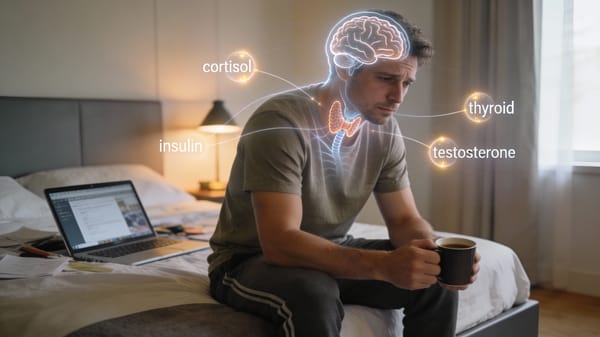
Research shows that after 40, multiple systems shift at once:
- Sex hormones like testosterone and others gradually decline.
- Sleep quality often drops, which further disrupts hormones and mood.
- Metabolism slows, weight creeps up, and blood sugar becomes harder to control.
- Chronic stress and “always on” living raise cortisol, which impacts libido, erections, and emotional resilience.
These changes do not mean your best nights are over.
They mean your body is asking for a different kind of care than it needed at 25.
What is really changing after 40?
Hormones: The quiet shift you feel, but rarely see
For men, testosterone is a key player in drive, energy, mood, muscle, and blood flow.
It does not suddenly fall off a cliff at 40, but it does tend to decline gradually over time.
Low or suboptimal testosterone can show up as:
- Less interest in sex
- Weaker or less frequent morning erections
- More body fat, especially around the belly
- Lower motivation and drive
- Irritability or “flat” mood
This hormonal shift is not just about the bedroom.
It influences how you feel about yourself as a whole—your confidence, your presence, your sense of power in your own life.
Other hormones also change:
- Cortisol (stress hormone) may stay higher for longer when life is demanding.
- Insulin may become less efficient, making it easier to gain fat and harder to lose it.
Together, these shifts can make it feel like your body is not playing on your team anymore.
Sleep: The invisible foundation of desire
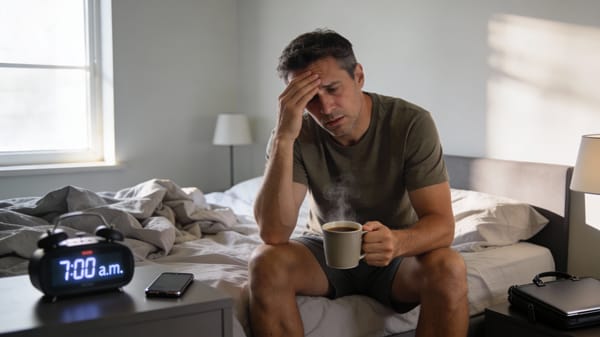
Sleep is often the first thing to erode in midlife and the last thing anyone talks about.
Research shows that poor or short sleep can:
- Lower testosterone
- Increase fatigue and brain fog
- Raise stress and anxiety
- Increase the odds of sexual response problems
If you feel too tired to initiate, too exhausted to stay engaged, or too wired at night to relax into connection, your sleep is almost certainly part of the story.
Stress: The silent intimacy killer
Stress does not just live in your inbox or bank statements.
It lives in your nervous system.
Chronic stress keeps your body in “fight-or-flight” mode, not “rest-and-connect” mode.
That shift can:
- Constrict blood vessels and negatively affect erections
- Disrupts hormone balance
- Make it harder to be present with your partner
- Fuel irritability, withdrawal, or emotional distance
No amount of willpower can override a nervous system that genuinely believes it is under threat.
To have better nights, your body needs to feel safe, not just willing.
Metabolism, cravings, and confidence
As metabolism slows and weight creeps up, it is not just a physical change—it is emotional.
You might:
- Avoid being seen naked.
- Turn off lights or avoid certain positions.
- Worry that you are no longer attractive.
Metabolic shifts after 40 often include:
- Increased belly fat
- Higher blood sugar
- Reduced muscle mass
- More intense cravings when stressed or tired
These changes can affect blood flow, stamina, and how comfortable you feel in your own skin.
And when you do not feel good in your body, it is much harder to surrender to pleasure.
The emotional weight of feeling like your best nights are over
Sexual changes are rarely just physical.
They touch identity, worth, and the story you tell yourself about ageing.
You might think:
- “I am letting my partner down.”
- “They are going to think it is them.”
- “I am not the man I used to be.”
Studies in older adults show that sexual response problems often go hand-in-hand with fatigue, poor sleep, anxiety, and depressed mood.
That means what you are experiencing is not a sign of weakness—it is a real, multi-layered health issue.
The pain is not only about performance; it is about connection.
About wanting to feel wanted, alive, and capable again.
Why does giving up feel easier than trying
After a few bad experiences—loss of erection, difficulty finishing, feeling disconnected—it can be tempting to just…stop trying.
People start to:
- Avoid intimacy out of fear of “failing.”
- Stay up later on their phones to dodge closeness.
- Lean on work, scrolling, or food as distractions.
It is a self-protective move.
If you do not try, you cannot be disappointed.
But over time, this avoidance builds distance.
Partners begin to wonder if they are unwanted.
You may start to grieve a part of your life that feels like it is fading away.
Before you accept that story, you deserve to know this:
Most of what you are experiencing is changeable, not permanent.
Reframing the story: Your body is not your enemy
What if, instead of seeing your body as broken, you saw it as overloaded?
- Overloaded with stress.
- Overloaded with responsibilities.
- Overloaded with years of under-sleeping, over-caffeinating, and pushing through.
Your body is not against you.
It is asking for different inputs.
Improving your nights is less about forcing performance and more about restoring capacity: capacity for energy, for relaxation, for desire, for connection.
Step 1: Start with sleep (even if that sounds boring)
Good nights in the bedroom start with good nights in bed—sleeping.
Research links better sleep with:
- Higher testosterone
- Improved mood and energy
- Better sexual function and satisfaction
Supporting sleep can mean:
- Setting a regular sleep and wake time most days.
- Reducing bright screens and heavy mental stimulation an hour before bed.
- Creating a pre-sleep routine that helps your nervous system downshift (reading, stretching, breathing, journaling).
This is not about perfection.
Even a small improvement in sleep quality can ripple out into better energy, more patience, and a body that is more responsive to touch and arousal.
Step 2: Address stress like it actually matters to your sex life
Stress is not a side note—it is central.
Chronic stress has been linked to hormone disruption, decreased libido, and sexual dysfunction in midlife and older adults.
Stress support might include:
- Short daily walks with no phone.
- Breathing practices (for example, 4 seconds in, 6 seconds out) a few times per day.
- Boundaries with work—especially late-night email or messages.
- Honest conversations with your partner about what you are carrying.
The goal is not a stress-free life—that is not real.
The goal is a nervous system that spends more time in rest-and-digest than in fight-or-flight.
That is the state where arousal and connection are actually possible.
Step 3: Move your body for blood flow, not punishment
Exercise after 40 is less about “earning” your food and more about supporting circulation, hormones, and mood.
Lifestyle research suggests that regular activity can:
- Improve blood flow (essential for erections and arousal).
- Support healthier testosterone levels and insulin sensitivity.
- Reduce stress and improve sleep.
This does not require extreme training.
Think in terms of:
- Regular walking
- A couple of strength sessions per week (even simple bodyweight work)
- Movement you actually enjoy enough to repeat
Movement is one of the fastest ways to remind your body: you are alive, you are capable, you are still in here.
Step 4: Support your metabolism and cravings instead of fighting them
If evenings are a blur of snacking, scrolling, and exhaustion, you are not alone.
Hormone and metabolic changes after 40 make it easier to:
- Store fat, especially around the middle
- Crash in energy mid-afternoon or evening
- Crave quick carbs or late-night snacks
This is not just a willpower problem.
It is a signalling problem.
Gentle ways to support your metabolism and cravings include:
- Eating enough protein and fibre to feel satisfied.
- Choose most of your carbs from whole foods instead of refined sugar.
- Not going so long without eating that you become ravenous and lose control.
Stable blood sugar and fewer crashes can translate into:
- More steady evening energy
- Less “food guilt”
- More bandwidth for intimacy instead of just survival
Step 5: Talk about what is happening—without shame
One of the most healing steps you can take is also one of the scariest: talking honestly with your partner.
Sexual response problems in older adults are strongly linked to mental health—anxiety, low mood, and relationship strain.
Silence usually makes those problems worse.
You do not have to have the “perfect” words.
You can try something simple like:
- “I have noticed some changes, and it is not you—it is my body, my energy, my stress.”
- “I still want you. I just also need to figure out what my body needs now.”
Most partners are relieved to know it is not about their attractiveness or worth.
From that honesty, you can start to build a new, more compassionate chapter together.
Step 6: When it makes sense to consider extra support
Once you have started working on sleep, stress, movement, and nutrition, it is reasonable to ask:
“Is there anything else that can help support my energy, mood, and drive?”
This is where targeted support can play a role—not as a substitute for lifestyle, but as a reinforcement.
For some men, that may include testing and working with a healthcare professional around hormones.
For others, it may include evidence-informed nutritional support aimed at stress, energy, and circulation.
The key is this: any tool you use should work with your body, not against it.
A supportive ally: AlphaFuel Pro V2
One example of a multi-action formula designed with men over 40 in mind is AlphaFuel Pro V2.
It is presented as a natural, botanical-based supplement formulated to support male vitality, blood flow, and overall performance—physical and intimate—without relying on harsh stimulants.
According to its official description, AlphaFuel Pro V2 includes a blend of:
- Tongkat Ali and Horny Goat Weed, traditionally used to support healthy testosterone, libido, and circulation.
- Ashwagandha and Maca, adaptogens known for helping with stress resilience, stamina, and mood.
- Additional plant extracts and nutrients that support vascular health, metabolic function, and sustained daily energy.
It is not a magic pill, and it is not a replacement for medical care.
But it can act as a supportive partner for men rebuilding their foundation after 40.
Appetite control and metabolism support
When stress is high and energy is low, appetite can feel chaotic—undereating all day, overeating at night.
By supporting hormonal and stress balance, AlphaFuel Pro V2 is described as helping the body maintain more stable energy and metabolic signalling.
That steadier internal environment can indirectly support healthier appetite patterns and fewer extreme cravings, especially when combined with balanced meals and movement.
A more efficient metabolism and better-calibrated hunger signals make it easier to maintain a body you feel comfortable in—which matters deeply for confidence in the bedroom.
Energy levels and mood balance
Fatigue and flat mood are two of the most common complaints for men over 40.
The adaptogenic herbs in AlphaFuel Pro V2—like ashwagandha and maca—are traditionally used to:
- Support more consistent daily energy
- Help the body cope with stress
- Promote a calmer, more stable mood
Feeling a bit more energised and less irritable can make an enormous difference in how open you feel to connection, intimacy, and trying again after setbacks.
Stress reduction and performance
AlphaFuel Pro V2’s formula emphasises not just circulation and testosterone, but also stress and fatigue management, through adaptogens that help regulate the stress response.
By easing the internal pressure of constant emphasis, it can help:
- Reduce the mental chatter that shuts down desire
- Support more relaxed, present experiences with your partner
- Complement the work you are doing with sleep, boundaries, and self-care
Again, this is support—not a guarantee.
But for many men, a little extra help in calming the nervous system and supporting blood flow can be the difference between “why bother” and “maybe I will try again.”
You are not past your prime—you are in a new chapter
If you take nothing else from this article, let it be this:
Your best nights are not defined by your age; they are defined by your attention.
- Attention to sleep.
- Attention to stress.
- Attention to hormones and metabolism.
- Attention to your own feelings and fears.
- Pay attention to your partner and the conversations you have been avoiding.
Changes after 40 are real—but so is your capacity to respond to them.
With time, support, and healthier foundations, it is entirely possible to build nights that are deeper than what you had in your 20s—more connected, more honest, more grounded in who you actually are now.
If this resonates with you, consider:
- Talking with a healthcare professional about hormones, sleep, and overall health.
- Making one realistic change this week (earlier bedtime, daily walk, less late-night scrolling).
- Exploring supportive tools like AlphaFuel Pro V2 as part of a broader, balanced plan to nurture appetite control, energy, mood, metabolism, and stress resilience.
You are not broken.
You are not alone.
And your story—inside and outside the bedroom—is not over.
It is still being written, one honest choice and one hopeful night at a time.
Ready to Feel Like Yourself Again?
If you are over 40 and tired of feeling drained, disconnected, or past your prime, you do not have to keep waiting for “someday.” With the right habits—and smart support like AlphaFuel Pro V2 to help with appetite control, energy, mood, metabolism, and stress—you can start rebuilding your best nights from the inside out.
Listen to your body, talk to your doctor, and if it feels right for you, try AlphaFuel Pro V2 today as part of a balanced plan to support your health, confidence, and connection.