The Hidden “Pressure Valve” Fix That Brought My Marriage Back to Life
Love was still there, but the spark was gone—buried under stress, exhaustion, hormones, and silent resentment. This story reveals the hidden “pressure valve” fix that helped release that tension, restore energy and desire, and gently bring a struggling marriage back to life without miracle promises


A lot of marriages do not break in one loud moment.
They leak.
A snapped comment here, a cold shoulder there, two people lying back-to-back in bed, wondering how they went from best friends to tense roommates.
If you are reading this and thinking, “That sounds like us,” you are not alone—and you are not doomed.
What changed everything for one couple was not a grand gesture or a perfect vacation.
It was a hidden “pressure valve” fix: learning how to release the constant build‑up of physical, emotional, and hormonal stress that had been quietly suffocating their connection.
When love is there, but the spark is not
Picture this.
Two people who genuinely love each other, share a home, kids, responsibilities, dreams—and yet feel like strangers.
They argue about small things: dishes, bills, phones at the table.
They are both tired.
Nights that used to feel playful and effortless now feel heavy, loaded with expectation or avoidance.
Underneath the surface fights is something deeper:
- Chronic stress
- Exhaustion
- Hormonal shifts
- Unresolved resentment
- A body that feels slower, softer, and less responsive than it used to
Research on couples shows that ongoing relationship stress can alter hormone patterns, increase inflammation, and disrupt sleep—key systems that shape mood, desire, and health.
In other words, your marriage stress is not “just in your head.”
It is in your bloodstream.
The invisible pressure no one talks about
Stress, hormones, and survival mode
When life feels like a never‑ending to‑do list, your body switches into survival mode.
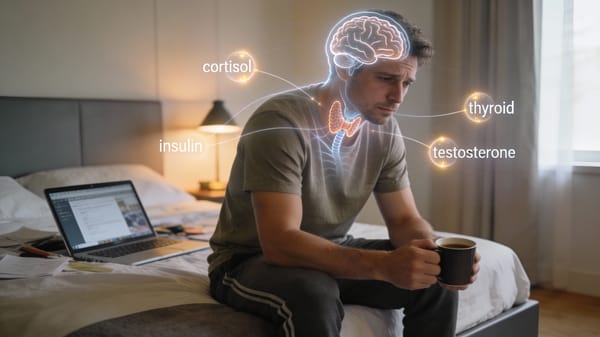
The stress hormone cortisol rises to help you cope with demands.
In the short term, that is useful.
In the long term, chronic stress:
- Disrupts testosterone and other sex hormones
- Increases fatigue and anxiety
- Blunts libido and arousal for both men and women
Studies show that chronic stress is linked to lower sexual desire, more difficulty becoming aroused, and less satisfaction with intimacy.
So when you feel “too tired,” “not in the mood,” or “disconnected,” it is not because you do not love your partner—it is often because your body thinks there is no room for pleasure when it is busy trying to survive.
Sleep and relationship strain
Sleep and relationships are tightly intertwined.
Troubled relationships are linked with worse sleep, and poor sleep, in turn, worsens mood and conflict.
Lack of quality sleep can:
- Raise cortisol further
- Lower testosterone and other key hormones
- Make you more emotionally reactive and less patient
Over time, this creates a feedback loop:
Fights → poor sleep → worse hormones and mood → more fights.
Your marriage is not failing because you cannot communicate about dishes.
It is struggling because two nervous systems are overloaded and underslept.
Metabolism, cravings, and self‑image
As stress and sleep issues accumulate, metabolism and weight are often affected as well.
Chronic stress and hormonal imbalance can:
- Increase cravings for high‑sugar, high‑fat foods
- Promote fat storage, especially around the belly
- Lower energy and motivation to exercise
That can leave you feeling:
- Less confident naked
- More inclined to avoid intimacy
- More likely to assume your partner is no longer attracted to you
Suddenly, the bedroom is not just about sex.
It is about body image, shame, and the fear of being judged.
The “pressure cooker” marriage
If you put this all together—stress, poor sleep, hormone shifts, low energy, cravings, weight gain, self‑doubt—you get what many couples live in without naming it:
A pressure cooker marriage.
Signs you might be in one:
- Small issues escalate quickly
- Kindness feels scarce
- One or both partners feel constantly “on edge”
- Intimacy is rare, strained, or feels like a performance
- Both of you feel unseen, even when you are in the same room
Research on couples shows that marital stress can affect cardiovascular, endocrine, and immune systems, contributing to long‑term health problems.
But before it harms the body, it breaks down daily life: shared laughter, easy touches, and basic emotional safety.
At some point, one or both partners think, “Maybe this is just how it is now.”
That is the moment when many people either shut down or seek a way to release the pressure.
What the “pressure valve” really is
The pressure valve is not one pony.
It is a way of living that releases, not stores, the physical and emotional stress building between you.
Think of pressure in three layers:
- Body pressure – hormones, sleep, metabolism, energy.
- Brain pressure – worry, resentment, to‑do lists, constant distraction.
- Relationship pressure – unspoken needs, unmet expectations, small daily hurts.
When all three build up, the system eventually explodes—or goes numb.
The “hidden fix” is not to pretend the stress is not there, but to give it consistent, safe exit points.
Step 1: Lower the body’s stress load
You cannot reason or “talk through” your way out of survival mode if your body is flooded with stress hormones all day.
Research shows that chronic stress and poor sleep can suppress testosterone, disturb cortisol rhythms, and impair sexual function.
So a key part of bringing intimacy back to life is helping the body feel safe again.
Practical shifts can include:
- Protecting a consistent sleep window as a shared priority
- Cutting late‑night scrolling and doom‑scrolling in bed
- Adding light daily movement (walks, stretching, basic strength work) to improve mood and blood flow
These are not glamorous.
But they are like opening small vents in a pressure cooker throughout the day.
Step 2: Create emotional “release valves”
Many couples wait until a huge fight to say what has been bothering them for weeks or months.
By then, it is not communication.
It is combustion.
A healthier “pressure valve” looks like:
- Short, regular check‑ins (10–15 minutes) where the goal is to listen, not fix
- Saying “I feel…” instead of “You always…”
- Naming stressors outside the relationship (work, health, finances) so they do not silently spill into the marriage
Studies link better relationship functioning with healthier stress hormone patterns across the day.
So when you improve the emotional climate—even a little—you are not just avoiding fights.
You are literally changing how your body handles stress.
Step 3: Rebuild small moments of safety and kindness
People often think “spark” means big, grand gestures.
But for a nervous system in survival mode, spark actually begins with safety.
Positive couple interactions are associated with better sleep and lower stress.
That means:
- Friendly touches in passing
- Genuine “thank yous” for small tasks
- Short, shared moments of humour or remembering good times
These small acts are like repeated signals to the body: you are safe with this person.
Only when safety returns can desire and playfulness follow.
Step 4: Understand how male hormones tie into the connection
In many marriages, the “pressure valve” is especially crucial for men, because they often carry silent pressure around performance, energy, and desire.
For men, testosterone plays a central role in:
- Energy levels
- Mood and motivation
- Muscle and metabolism
- Libido and erection quality
When chronic stress, poor sleep, and ageing start to drag testosterone down, men may feel:
- Less driven in life and in the bedroom
- More irritable or flat
- More easily fatigued
- Less like “themselves”
Studies show that sleep loss and ongoing stress can reduce testosterone and increase cortisol, feeding a loop of fatigue, low mood, and reduced desire.
Without understanding this, many couples misinterpret hormonal shifts as disinterest or rejection.
Recognising that hormones, metabolism, and sleep are part of the story does not excuse disconnection—but it does explain it.
And what is understood can be worked with.
Step 5: Make peace with changing bodies
Over the years, metabolism slows, weight changes, and cravings react to stress.
Men may notice more belly fat and less muscle; women may experience their own hormonal transitions.
This can create a quiet, painful narrative:
“I am not attractive anymore.”
“They must be comparing me to my younger self.”
That shame is its own kind of pressure.
Releasing it requires:
- Speaking honestly about insecurities instead of hiding them
- Focusing intimacy on connection, not performance or perfection
- Remembering that your partner chose you for far more than a specific body shape
When both people feel more accepted, the body relaxes.
And a relaxed body is much more capable of pleasure.
When outside support becomes part of the “pressure valve”
Even with better sleep, communication, and daily habits, some couples find that energy, mood, and drive still feel fragile—especially for men navigating midlife hormones and chronic stress.
At that point, it can make sense to look at targeted support for:
- Energy levels
- Mood balance
- Stress resilience
- Metabolic health
- Sexual vitality
This is where some men explore options like hormone testing, therapy, or well‑designed nutritional support meant to work with the body’s natural systems, not against them.
One example of such support is AlphaFuel Pro.
AlphaFuel Pro is a supportive “pressure valve” for men
AlphaFuel Pro is presented as a natural, plant‑based supplement formulated to support male vitality by helping blood flow, testosterone balance, and daily energy.
It is not a miracle cure, but it can be one part of a broader “pressure valve” plan for men who feel worn down by stress and age.
According to expert reviews, AlphaFuel Pro combines several herbal extracts and nutrients—such as Tongkat Ali, Horny Goat Weed, and other botanicals—aimed at:
- Supporting healthy testosterone production
- Enhancing circulation and vascular health
- Reducing fatigue and supporting stamina
Here is how that can relate to your marriage in a realistic, grounded way.
Appetite control and metabolism
Chronic stress and poor sleep often lead to emotional eating, cravings, and weight gain—especially around the midsection.
By supporting hormonal balance, energy, and metabolic health, AlphaFuel Pro may help:
- Reduce the intensity of stress‑driven cravings
- Support a more efficient metabolism when combined with good nutrition and movement
- Make it easier to maintain or move toward a body you feel more comfortable in
This is not about chasing a magazine physique.
It is about helping your body feel lighter, more responsive, and more like a place you want to inhabit—especially next to someone you love.
Energy levels and mood balance
Many men in stressed marriages are not uninterested in their partners—they are just exhausted.
The ingredients in AlphaFuel Pro are formulated to support:
- More stable daily energy
- Fewer mid‑day crashes
- Better drive and motivation
Some components are also associated with improved mood and reduced fatigue, which can make it easier to:
- Initiate connection
- Stay present and engaged
- Handle conflict without shutting down
Again, this is support, not a personality transplant.
But a small lift in energy and mood can create space for more kindness and closeness.
Stress reduction and nervous system support
Because so much marital pressure comes from stress, anything that helps the body handle stress more smoothly can be part of the “pressure valve.”
By working on hormonal balance and circulation, AlphaFuel Pro may indirectly help regulate cortisol patterns and stress response over time.
Some users and reviewers describe feeling more “even” and less reactive when their energy and hormones are better supported.
That calmer internal state can make:
- Honest conversations are less explosive
- Small annoyances are easier to shrug off
- Intimacy feels less like a test and more like an invitation
AlphaFuel Pro will not fix communication or heal old wounds.
But it can help create a body and mind that are better equipped to do that emotional work.
Bringing it all together: your marriage is not a lost cause
“The Hidden ‘Pressure Valve’ Fix That Brought My Marriage Back to Life” is not a fairy tale.
It is the real story of what happens when two people stop blaming each other and start releasing the pressure that has been damaging their bodies, their hormones, their sleep, and their hearts.
The pressure valve is:
- Letting your nervous system rest through better sleep and simple routines
- Sharing the emotional load instead of carrying it alone
- Caring for your body—movement, food, and, when appropriate, supportive tools like AlphaFuel Pro to bolster appetite control, energy, mood, metabolism, and stress resilience
If any part of this feels like your life, know this:
You are not broken.
Your partner is not your enemy.
And your marriage is not a machine that needs one magic part—it is a living system that can heal when pressure finally has somewhere to go.
Consider talking with a healthcare professional about stress, hormones, and sleep.
Pick one small “pressure valve” to open this week—a walk together after dinner, screens off earlier, a real conversation that begins with, “I miss us.”
And if it feels right for you, explore options like AlphaFuel Pro as part of a thoughtful, long‑term approach to rebuilding your energy, mood, and vitality from the inside out.
Your marriage does not need perfection.
It needs two humans, in progress, choosing to lower the pressure and stay in the room together.